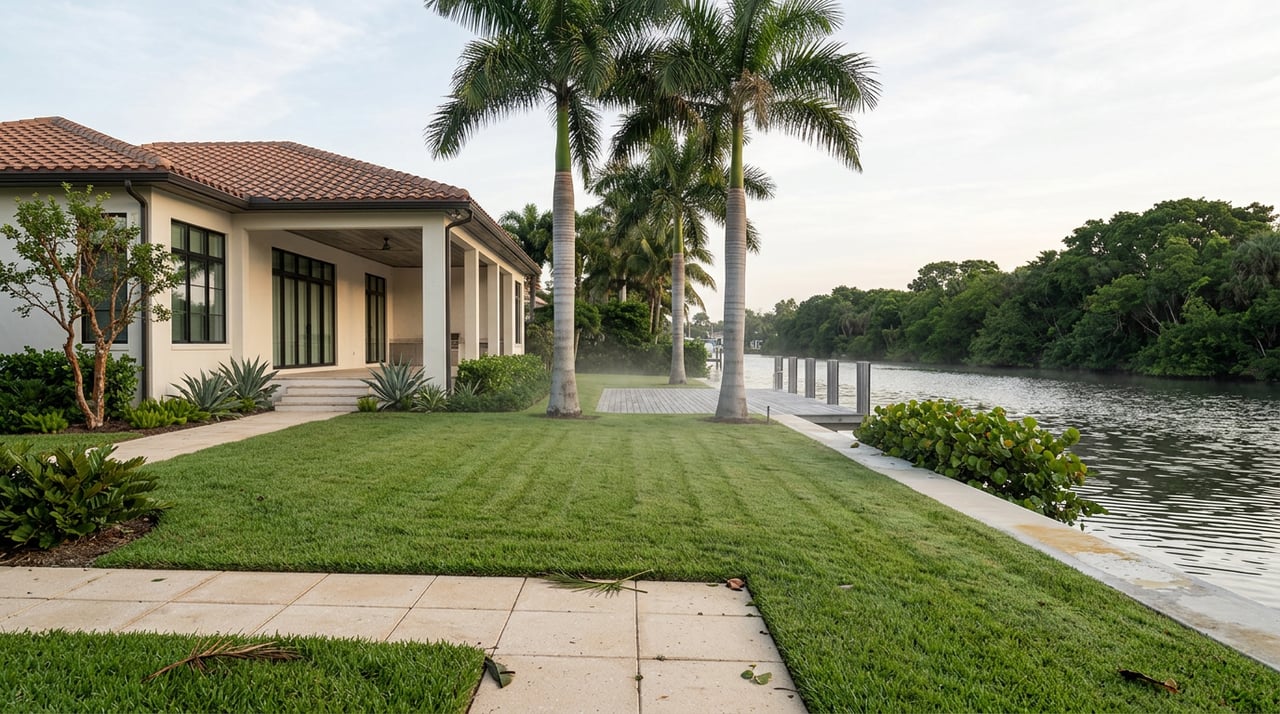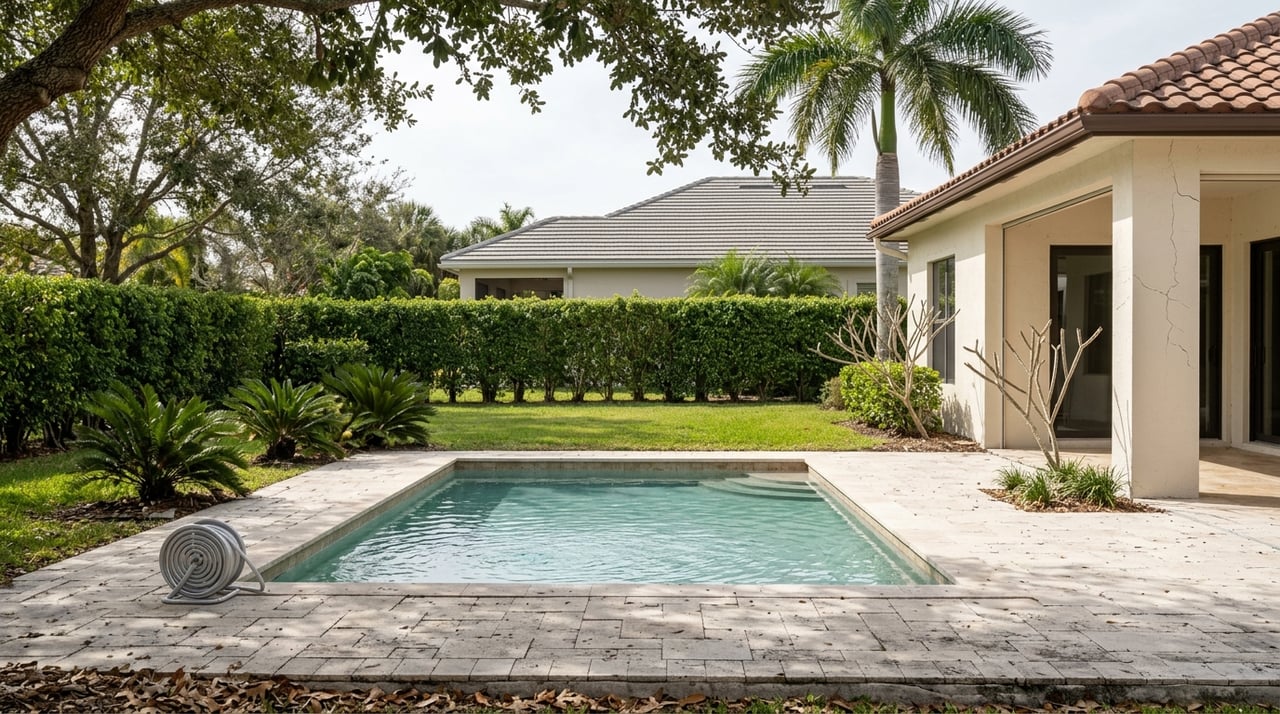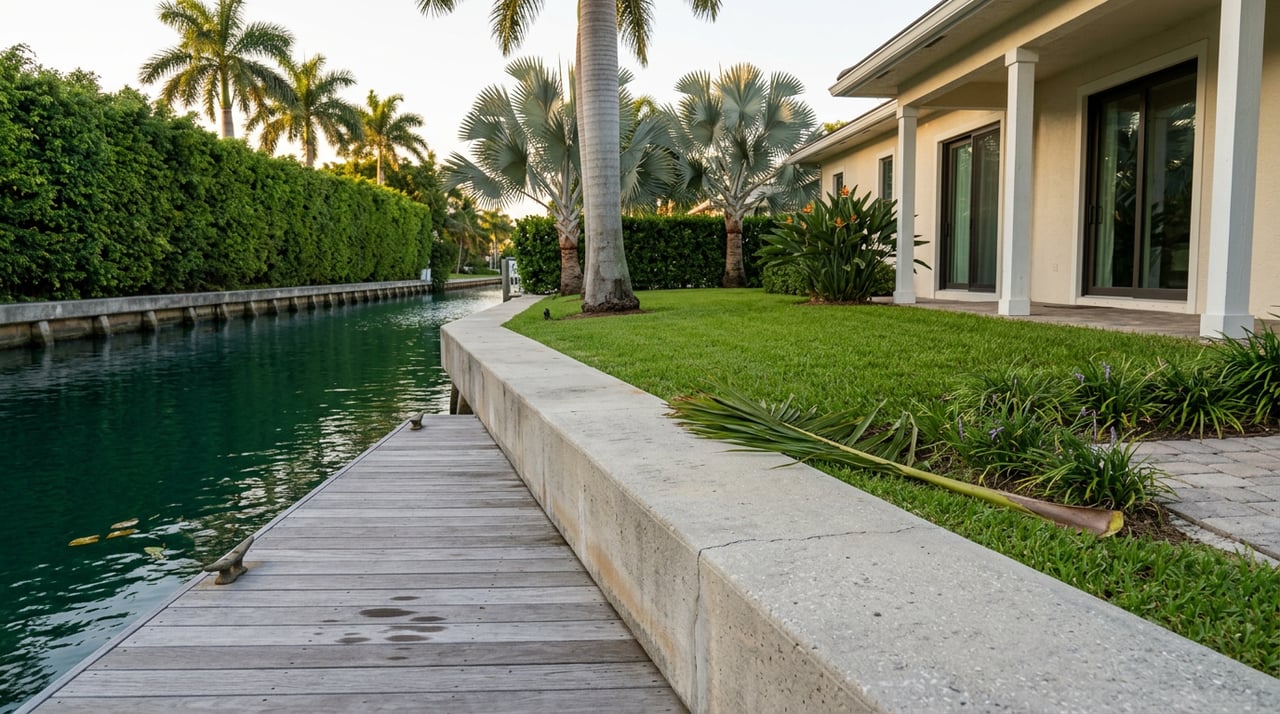
Ask Fort Lauderdale's assistant public works director whether homeowners need to worry about the city's newer, taller seawall standard, and her answer is short: "probably not." Nancy Gassman said as much in a city explainer on the March 2023 ordinance that raised the required top elevation from 3.9 feet to 5 feet NAVD88. For most of the city, that reassurance holds. Rio Vista is not most of the city.
Rio Vista took shape in the prosperous years after World War I, which makes it one of the oldest platted waterfront communities in Fort Lauderdale. Its canals and New River frontage filled in with construction that continued heavily through the 1950s and 1960s, and a seawall built in that era carries an average working life of roughly 50 years. Do the arithmetic on a wall poured in 1966 and you land somewhere past its design life right now, in 2026. That single fact changes how a routine repair conversation plays out here compared to almost anywhere else in the city.
The Line That Decides Repair or Rebuild
Fort Lauderdale's own code already requires new and substantially repaired seawalls to hit 5 feet NAVD88, ahead of Broward County's countywide phase-in, which allows a lower 4-foot standard through January 1, 2035 before stepping up to the same 5-foot mark by 2050. The county's resiliency code, under Policy 2.21.7 and Chapter 39 Article XXV, defines what pushes a project from ordinary repair into that mandatory upgrade: work touching more than half the wall's linear length, or repair costs exceeding half the wall's value. Cross either line and the code treats the whole project as new construction, regardless of what the homeowner intended to fix.
That threshold is not a formality. A contractor called out to patch one cracked panel and reseal a few joints can find, once the wall is actually opened up and inspected below the waterline, that the damage already extends across more than half the shoreline run. At that point the choice to do a modest repair is no longer available. The project becomes a full rebuild, permitted at current elevation, and the county's code adds one more line item that surprises owners every time: new or substantially repaired flood barriers must include natural lime rock riprap or another approved habitat enhancement at the water-facing side, a requirement a simple patch job never had to account for.
What the Two Paths Actually Cost
The dollar gap between staying under that line and crossing it is not small.
| Scope of work | Typical cost | When it applies |
|---|---|---|
| Crack injection, spot panel repair, cap resurfacing | $100–$250 per linear foot | Damage stays below the substantial-repair threshold |
| Full panel and tieback replacement | $400–$600 per linear foot | Once repair scope crosses 50 percent of wall length or value |
| Urban or exposed-water sites, including New River and deep-water canal frontage | $1,200–$2,000 per linear foot | Engineering and site-access complexity push costs higher |
| Demolition and permitting on a full rebuild | $10,000–$30,000 added | Applies once the old wall must come out entirely |
On a typical 100-foot Rio Vista lot, the difference between staying inside the repair category and tripping into full replacement is not a rounding error. It is the difference between a five-figure invoice and a six-figure one, sometimes well past $125,000 once demolition, engineering, and habitat mitigation are added in.
Why Age Works Against the Smaller Number
A newer seawall can absorb a crack or two and still stay well under the 50 percent line, because the surrounding structure is sound. An older wall, especially one nearing or past that 50-year mark, tends to fail in a distributed way: tie-backs loosen in several places at once, soil migrates behind multiple panels rather than one, and cap deterioration shows up along a longer stretch than the visible crack that prompted the call in the first place. The age of the wall does not just raise the odds that repair will eventually be needed. It raises the odds that whatever repair is needed already qualifies as substantial once an engineer actually measures it against the wall's full length and cost.
That is the part of this story that rarely makes it into a listing conversation. The seawall looks fine from the dock. The real number, the one that decides which column of that table applies, sits below the waterline where nobody is looking until an inspection period forces the question.
What That Means for a Listing's Timeline
Neighborhood-level housing data for Rio Vista, as of February 2026, put the average time on market at 107 days, against a national average of 54. The trailing 12-month median sale price sat near $2.3 million, down 18 percent from the prior 12-month period, while the average sale price in the same snapshot ran closer to $2.8 million. None of that is proof that seawall condition alone is driving the pace of these transactions. Waterfront sales carry plenty of variables. But the mechanics fit a neighborhood where a meaningful share of the seawall inventory is old enough to sit right at the substantial-repair line. Ordering a NAVD88-referenced survey, getting an engineer's report, and collecting contractor bids that already account for the 50 percent test all take real calendar time, and none of it happens in a neighborhood built mostly after 2000.
What Insurance Does Not Solve
Buyers sometimes assume a policy will absorb this risk if the wall fails after closing. It generally will not. Standard homeowners insurance typically excludes deterioration from age or neglect, covering only sudden damage from a named storm or a similar event. Flood coverage through the National Flood Insurance Program generally excludes seawalls altogether. The cost of bringing a wall into compliance sits with the property, not with any policy sitting behind it, which is exactly why the paperwork matters more here than it does on a newer canal lot.
The Paperwork That Actually Settles the Question
Before a seawall conversation turns into a negotiation, both sides benefit from the same short list of documents:
- A property survey referenced to NAVD88, not to today's tide line, showing the wall's actual current elevation
- An engineer's inspection report detailing crack pattern, tie-back condition, and toe erosion, since these details determine whether the needed work already crosses the 50 percent mark
- Permit history and records of any prior repairs, since a wall touched within the last decade may already be partway toward the threshold
- A contractor's cost breakdown that separates ordinary repair pricing from the full-compliance rebuild scenario, so an offer can be priced against either outcome
For sellers, gathering this before listing turns a potential mid-contract surprise into a known quantity buyers can price with confidence. For buyers, it is the single best use of an inspection contingency on any Rio Vista waterfront property built before the 1990s.
A Few Direct Questions
Does the city's 5-foot standard apply to every seawall in Rio Vista right now? No. It applies to new construction and to any wall whose repair scope trips the substantial-repair definition. A wall that has never needed major structural work is not required to be raised on its own.
Can an owner avoid the trigger by scheduling repairs in smaller phases? The threshold is measured against the total scope of the work once assessed, not against how a project happens to be scheduled. An engineer's evaluation before finalizing any partial repair plan is worth the cost simply to know where the actual damage stands relative to that 50 percent line.
Why does the survey have to reference NAVD88 specifically? NAVD88 is the fixed vertical datum surveyors and permitting agencies use for every seawall elevation reading in Broward County. A measurement against today's tide line will not match what the county checks against, so a survey that skips this reference point is not usable for permitting purposes.
For a look at what is currently listed in the neighborhood, our Rio Vista listings page reflects current inventory across the older, established sections of the neighborhood and the newer construction filling in beside them. Fort Lauderdale's full municipal code, including the seawall elevation standard, is available through the city's official code of ordinances for anyone who wants to read the underlying language directly.
Laurie's background sits on the construction and design side of this exact problem, reading engineering reports, understanding what a repair estimate is actually scoping, and translating that into a number a buyer or seller can act on with confidence. If a Rio Vista seawall is part of your next move, whether you are listing a property with one already on file or evaluating a purchase where the inspection period is about to matter, Laurie's Lauderdale Group can walk the documentation with you before it becomes a surprise. Request a Design + Market Consultation to start that conversation early, while there is still time to plan around it rather than react to it.